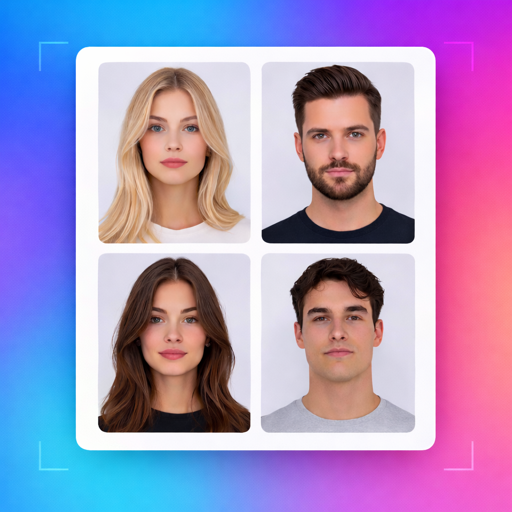
Can you smile in a passport photo?
The short answer
In the United States you may smile in a passport photo, as long as your mouth stays closed. Almost nowhere else allows it. The United Kingdom, Canada, France, Germany, the Netherlands, Ireland, Italy, Mexico and the Schengen visa standard all ask for a neutral expression with the mouth closed. Ireland's Passport Service puts it as a flat instruction: "Make sure your expression is neutral, do not smile and close your mouth." (Department of Foreign Affairs)
So if you are holding the phone right now: face square to the lens, eyes open, looking straight down the barrel, lips together, no teeth. Take it, then check the measurements. Expression is the one failure you can fix in the two seconds before you press the shutter.
On this page
What each authority actually says
These are the published wordings, not paraphrases of them.
| Authority | Expression rule |
|---|---|
| United States | A natural expression, or a natural closed-mouth smile. Glasses are not permitted at all. travel.state.gov |
| United Kingdom | "have a plain expression and your mouth closed", with your eyes open and visible. gov.uk |
| Ireland | "Make sure your expression is neutral, do not smile and close your mouth." ireland.ie |
| Netherlands | Three requirements only: "neutral expression", "looking straight at the camera", "mouth closed". netherlandsworldwide.nl |
| France | "L'expression doit être neutre et la bouche doit être fermée." service-public.gouv.fr |
| Canada | Neutral expression, mouth closed. canada.ca |
| Germany, Italy, Mexico, Schengen visa | Neutral, mouth closed. Mexico additionally rules out smiling by name. |
The United States is genuinely the odd one out, and it is worth being precise about how far the permission goes. A closed-mouth smile is allowed; teeth, a laugh or an exaggerated expression are not what the State Department describes. The same expression rule carries across to US visa photos, including the DS-160 upload, so the smile you may keep for a passport you may also keep for a visa — the difference between those two applications is in the file, not the face. Our passport photo versus visa photo guide covers where they actually diverge.
One face, two applications
People renewing a US passport and applying for a Schengen visa in the same month often reuse one photo. If you are shooting once and using the image twice, shoot neutral — it satisfies both sets of published wording, and a smile only satisfies one. See the Schengen visa photo page for the rest of that standard, which is messier than most people expect.
What "neutral expression" actually means
The word "neutral" causes more bad photos than the rule it describes. People read it as "look serious", overcorrect, and produce a photo of themselves looking bereaved. Nothing in the published guidance asks for that.
Read the Dutch rules and this becomes obvious. The Netherlands publishes exactly three requirements under the heading Expression: a neutral expression, looking straight at the camera, and the mouth closed. That is the whole list. There is no fourth item about mood, no instruction to suppress a friendly face, and no rule against looking like you are having a reasonable day. The Dutch original is even narrower than the English translation suggests — it says "neutrale blik", a neutral gaze, alongside "recht in de camera kijken" and "mond gesloten". The requirement is about where your eyes point and whether your lips are together.
The UK phrasing lands in the same place. GOV.UK asks for "a plain expression", not a grim one. In practice, "neutral" means:
- Lips closed and relaxed. Not pressed hard together, which pulls the mouth into a line and changes the shape of your chin.
- No visible teeth. This is the part that is actually being enforced.
- Eyes open, looking at the lens. Not up, not past it, not at the phone screen — at the lens itself, which on most phones is a few centimetres away from where your eyes want to go.
- Eyebrows in their resting position. Raised brows read as surprise and widen the eye region.
- Jaw unclenched. Say a long "mmm" and stop halfway; that is roughly the shape they want.
What none of these authorities publishes is a threshold. Not one of the pages above tells you how many millimetres of lift at the corner of the mouth becomes a smile, or how an assessor scores a borderline case. That silence is the honest reason to shoot neutral rather than nearly-neutral: you cannot appeal against a judgement whose criteria are unpublished, so the safest photo is the one that gives nobody anything to judge. Expression sits alongside glare on glasses and hair across the eyes in our list of why passport photos get rejected.
Babies and young children are the real exception
Every authority that writes rules for adults quietly gives up on them for small children, and the exemptions are unusually generous. They are also inconsistent, so check the one that applies to you rather than assuming.
United Kingdom. Children under six "do not have to be looking directly at the camera or have a plain expression". Children under one "do not have to have their eyes open". You may support the baby's head with your hand, but the hand must not be visible in the photo, and babies must not be holding toys or using dummies. (gov.uk)
Netherlands. Babies and children under six are exempt from all three expression requirements — neutral expression, looking straight at the camera, and mouth closed — and from three of the posture rules as well. Support must be hidden, and the guidance suggests putting the supporting hand under the child's clothing. But the Dutch table is explicit that a child with eyes closed is not permitted, so the Dutch exemption is narrower than the British one on exactly that point. The Netherlands also relaxes the geometry for children: chin to crown must be 26–30 mm from age 11, but 19–30 mm for ages 10 and under. (netherlandsworldwide.nl)
Ireland. No published age exemption for expression at all. Instead the Passport Service asks guardians "to make every effort to ensure that the child's expression is natural, that they are not smiling and their mouth is not open". Soothers and dummies are ruled out because they obscure facial features, and an infant who cannot support themselves should be photographed lying on a plain white surface with no hands or arms visible. (ireland.ie)
The practical read: for a British or Dutch baby, stop trying to stage a neutral face and concentrate on framing, background and the invisible hand. For an Irish child there is no such licence — best efforts, not an exemption. Our baby passport photo guide goes through the whole sequence, including the lying-down method.
Why the rule exists at all
The photo is not decoration on the page. In the EU, Regulation (EC) No 2252/2004 requires that "Passports and travel documents shall include a storage medium which shall contain a facial image", and its recitals say the point is to "establish a reliable link between the genuine holder and the document", with the specifications of ICAO Document 9303 to be taken into account. (EUR-Lex) Ireland's guidance attributes its six-month recency rule to ICAO directly.
Once you know the image is stored to be compared by machine against your live face at a border gate, the expression rule stops looking arbitrary. A neutral, mouth-closed face is repeatable. A smile is not: it moves the mouth, the cheeks and the skin at the outer corners of the eyes, and it moves them differently each time. The photo that flatters you is the photo that is hardest to reproduce on demand at half past six in the morning in an arrivals hall.
That is also why the United States being an exception is worth reading correctly. It is a policy choice by one issuing authority, not evidence that the underlying standard is soft. Every one of the authorities above sets its own tolerance on top of the same international specification, which is why sizes, background colours and head heights disagree so widely between countries that all claim to follow ICAO.
Getting the shot
Expression is free to fix and everything else is measurable. In order:
- Set the face first. Lips together, eyes on the lens, brows down, shoulders square. Take five frames, not one — the neutral one is usually the third or fourth, once you have stopped concentrating on being neutral.
- Do not use the front camera if you can avoid it. The rear lens is sharper on almost every phone, and a front-camera photo taken at arm's length puts your face far too close to a wide lens. See taking a passport photo with an iPhone.
- Check the geometry against the published range. Head height and eye line are the two numbers most home photos miss, and they are pass-or-fail arithmetic, not opinion. Our photo checker measures chin-to-crown and eye height in millimetres against the range the authority actually publishes, and flags sharpness, exposure, lighting, background and resolution.
- Crop to the right format. Start from 2 × 2 in for the US, 35 × 45 mm for the UK, 50 × 70 mm for Canada, the DS-160 upload, or pick from the full list of formats.
One thing our tool deliberately will not do: change your face. It crops, measures and checks, and it never retouches. That is not modesty about what software can do — it is that the UK requires the photo be "unaltered by computer software", the Netherlands publishes the identical requirement in its quality list, and the State Department says it checks photos for the use of artificial intelligence. The editing rules are stricter than most tools admit, and an expression is not something you can retouch your way out of anyway. Reshoot it; it takes eleven seconds.
Doing this on the website or in the app
Everything above runs in the browser on this site with no upload, no account and no limit on how many photos you make. There is also a free iOS app, Passport Photo: Photo Maker ID, which gives you one free export and then asks you to upgrade to Pro — the website is the unlimited one. When you are ready to print, the 4 × 6 print sheet builder tiles the crops at true physical size.
Whatever the software says, the decision belongs to the passport office. What you can control is that the photo matches the published wording — mouth closed, eyes on the lens, and, unless you are American, no smile at all.
Do it now
Crop, check and lay out a photo without leaving this tab.
Open a photo
It stays on this device. Nothing is uploaded, and there is no account, watermark or limit.
JPEG, PNG, WebP or HEIC. Drag a file here if you prefer.
Drag the blue line to the top of your hair, the red line to the bottom of your chin, and the green line to the centre of your face. The crop follows.
Every file carries its real print size, so a photo lab lays it out at the right dimensions instead of guessing 72 DPI.
Keep reading
Why you should not let software retouch your passport photo
They have just used a tool that replaced their background with white, and something they half-read has made them wonder whether that will get the application rejected.
What a passport photo actually costs
They are about to pay a counter price and want to know whether it is the going rate or whether they are being had.
Printing passport photos on a 4 × 6 sheet
They have a photo and want six of them on paper without paying counter prices, and every guide they have found skips the step where the print comes out the wrong size.